
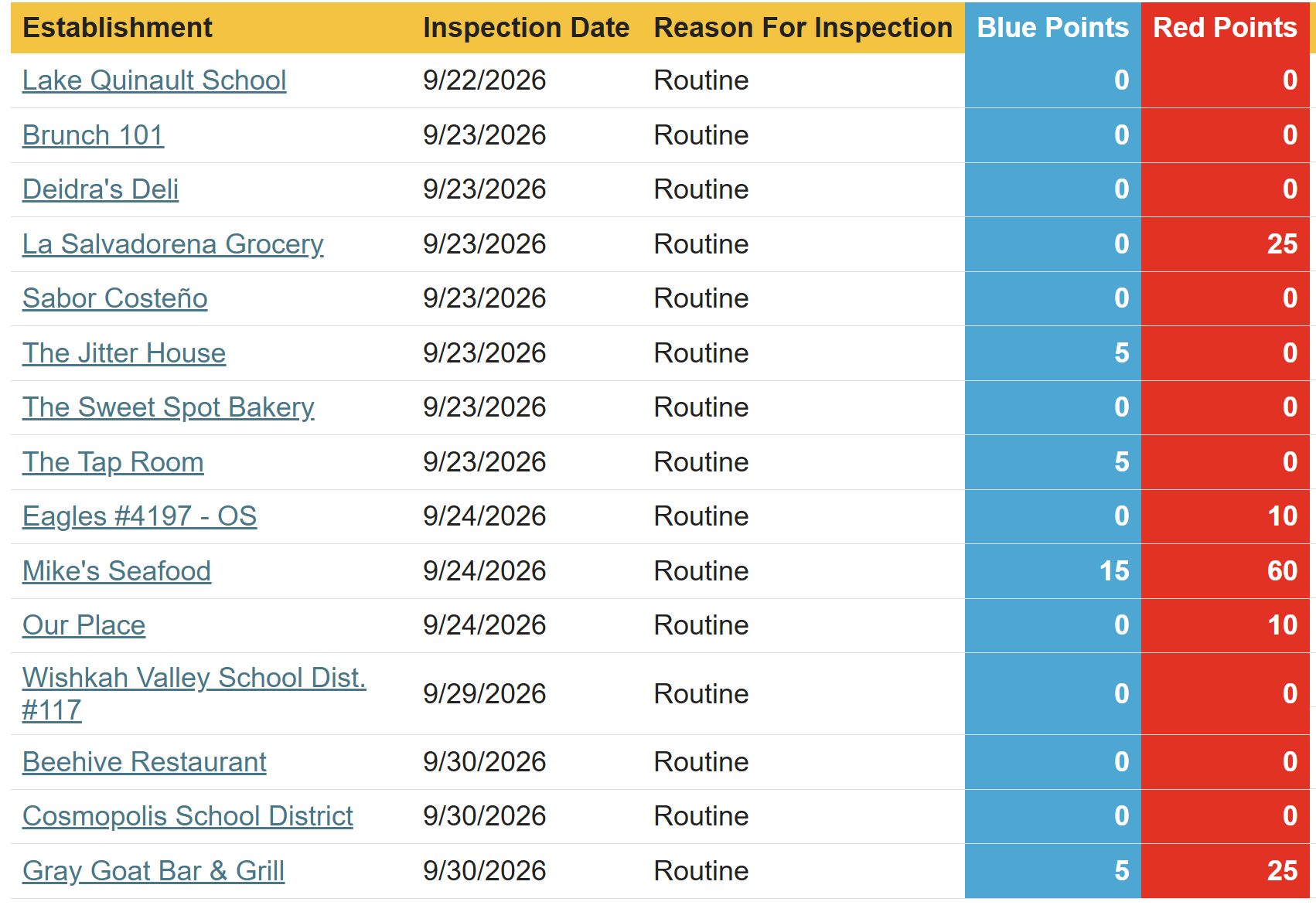
Grays Harbor County Division of Environmental Health has changed their format for releasing Restaurant/Health inspections. They now have a searchable database that does show the most recent inspections and we here at GHScanner have gone through those to make this "Recent Grays Harbor Resturaunt Inspections ".
Please keep in mind, these reports are just being made public and most establishments have most likely already corrected most issues that they faced. This is all the information we are provided with, so please do not ask much more as far as what the violations were for etc... For more information you can contact the Grays Harbor County Division of Environmental Health at (360) 249-4222 or
La Salvadorena Grocery — 9/23/2026 — 25 red points
Person-In-Charge (PIC) was selling unlabeled food and couldn't answer questions about the product when asked. Other red critical items were observed as noted in the report.Packaged products are not labeled as specified in law.Bagged chorizo and raw shell eggs stored above jalapenos in the reach-in refrigeration unit. No signs of cross contamination.
Mike's Seafood — 9/24/2026 — 60 red points
Person in charge is not maintaining active managerial control. Observed repeated red critical violations including improper handwashing, date marking, sanitizing procedures, and lack of Food Worker Cards. Processes are not being actively monitored and are out of compliance. Active managerial control not observed.
Corrective Actions: Certified Food Protection Manager (CFPM) is responsible for training PICs. Each PIC must be able to demonstrate knowledge and maintain active managerial control.Food workers working without a valid Food Worker Card.Handwashing did not occur during the inspection. Food workers changing tasks such as working with raw food to working with ready to eat food.Soap was not provided at the handwashing sink in the kitchen.Ready-to-eat TCS foods found without date marking including chowder, cooked potatoes, cooked vegetables, rice, and pasta.Shellstock tags observed without proper dates recorded. Establishment currently does not have shellstock product.Ice machine has visible buildup.Mechanical sanitizer temperature of the dishwasher was found to be 105°F even after running the unit multiple times.Non-food contact surfaces throughout the establishment have accumulations of dirt, grime, mold, and/or debris. Surfaces include but are not limited to the hood vents, walls, ceilings, equipment, equipment handles, exterior of sinks, shelving, and walk-in cooler surfaces. Significant buildup is present on the floors throughout the kitchen and cookline area. Foil and cardboard were observed being used to cover surfaces.Several unnecessary items were found throughout the establishment. PIC stated these items build up in the summer and then they remove them in the
Gray Goat Bar & Grill — 9/30/2026 — 25 red points
Chili that had been cooked within the hour was being cooled in a stainless-steel pan that exceeded two inches in depth. The pan was sitting on top of a covered container of previously cooled soup. The previously cooled soup was measured at 55°F. Time and temperature were not being monitored during the cooling process.Both ice machines were observed with visible buildup of grime and mold.
About The Inspections
These establishments include restaurants, food and espresso carts, coffee places, delis, the fresh food sections in grocery stores, temporary events where food is sold, and more.
There are nearly 500 permitted food service establishments in Grays Harbor County. The majority of these establishments have two unannounced inspections per year. Some food service establishments will receive at least one unannounced inspection annually and any restaurant may request a special educational session.
The purpose of the inspections is to assure that the food is being handled properly from preparation through serving. Inspectors observe kitchen workers' food handling practices, assure equipment is working properly, take food temperatures, inspect refrigerators and storage areas, assure water temperatures, and correct level and use of sanitizers. Any problem found is written up, and the manager is taught the correct procedure or method immediately.
There are two types of violations recorded on the inspection report.
"Red critical violations" are those food handling practices that, when not done properly, are most likely to lead to food borne illnesses. These food handling practices include:
- controlling temperature, such as cooking meats to the right temperature to kill food borne disease germs, keeping food hot enough until it is served, and keeping food cold enough
- cooling food properly, washing hands, and using utensils instead of bare hands on "ready to eat" food
- storing food
- serving practices
"Blue violations" are primarily maintenance and sanitation issues that are not likely to be the cause of a food borne illness.
Each violation has a numerical value based on its risk of foodborne illness. Therefore, there are more points given for red critical violations than for blue violations. Whenever possible, violations found during the inspection are corrected immediately. Red critical items found during the inspection must be corrected immediately. Examples would be re-heating a food to 165° F, putting it into the refrigerator or discarding the food.